


The statement of cash flows using the indirect method has been discussed in most introductory accounting courses. Since the statement of cash flows can be challenging, a review of the basic concepts is presented below. The indirect method works from net income, so the bottom of the income statement, and adjusts it to the cash basis. We will look at both methods with the same data, so you can see the differences in analysis, but the same ending number. The direct method, the income statement is reformulated on a cash basis, rather than an accrual basis from the top of the statement (the income part) to the bottom (the expense part). Companies may add other expenses and losses back to net income because they do not actually use company cash in addition to depreciation.
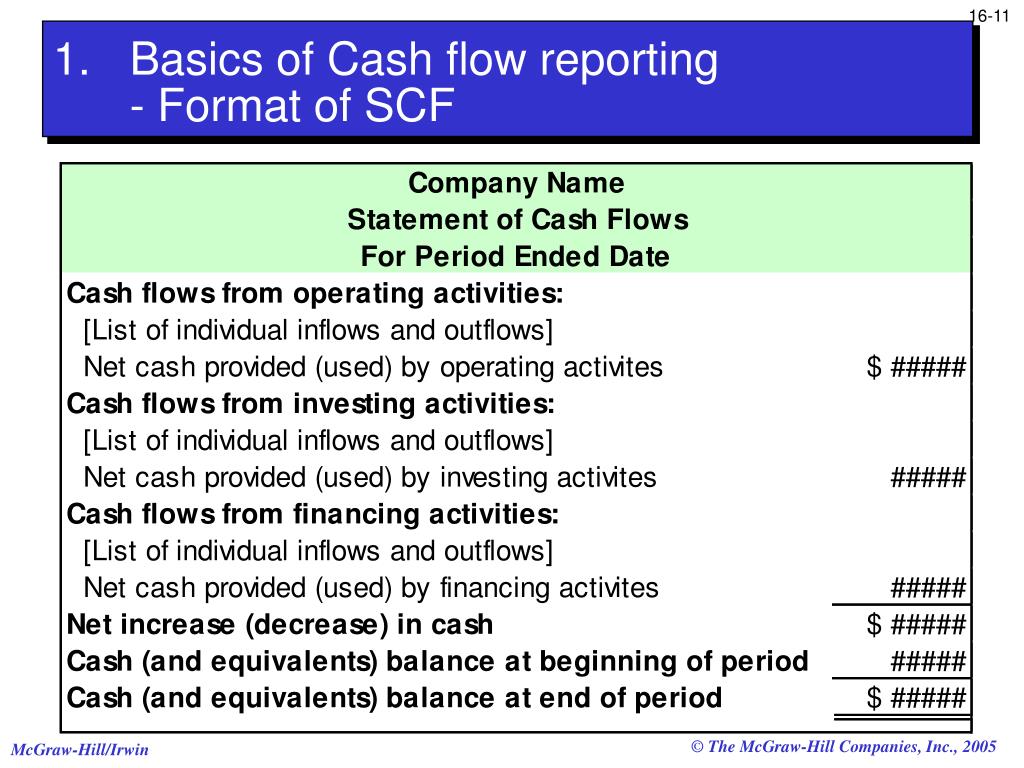
4 Format of the statement of cash flows
Note that the additional information in this example stated figures related to cash receipts from customers and cash paid to suppliers and employees. You may need to determine these for yourself by using the figures in the financial statements and the additional information provided in the question. The next section to complete is the investing activities section. The analysis of all of the non-current assets accounts must also take into account whether there have been any current year purchases, disposals, or adjustments as part of the analysis. The use of T-accounts for this type of analysis provides a useful visual tool to help understand whether the changes that occurred in the account are cash inflows or outflows, as shown below. The changes in working capital (i.e. inventory, trade receivables and trade payables) do not impact on the profit but these changes will impact cash and so further adjustments are made.
- Alternatively, the indirect method starts with profit before tax rather than a cash receipt.
- The profit on disposal of PPE of $500 ($2,000 – $1,500) would be adjusted for as a non-cash item under the operating activities (see later).
- When inventory increases, cost of goods sold on a cash basis increases (increasing cash outflow).
- This content is for general information purposes only, and should not be used as a substitute for consultation with professional advisors.
Comparing the Direct and Indirect Cash Flow Methods
The American Institute of Certified Public Accountants reports that approximately 98% of all companies choose the indirect method of cash flows. Note that, whichever method is used, the same figure is presented as the cash generated from operations and the net cash from operating activities. Cash receipts from customers, the reporting of investing activities is identical under the direct method and indirect method. including cash sales, were $800,000. Additional informationDuring the year, depreciation of $50,000 and amortisation of $40,000 was charged to the statement of profit or loss. Present value (PV) is defined as the current or present value of all future sums of cash flow or money at a specified rate of return.
Please Sign in to set this content as a favorite.
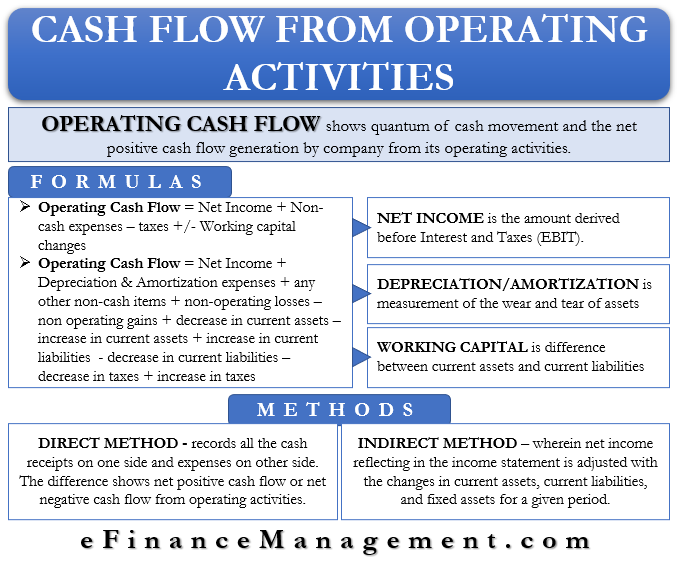
The first is the direct method which shows the actual cash flows from operating activities – for example, the receipts from customers and the payments to suppliers and employees. The second is the indirect method which reconciles profit before tax to cash generated from operations. Under both of these methods the interest paid and taxation paid are then presented as cash outflows deducted from the cash generated from operations to give net cash from operating activities. Cash flows from operating activities show the net amount of cash received or disbursed during a given period for items that normally appear on the income statement. You can calculate these cash flows using either the direct or indirect method. The direct method deducts from cash sales only those operating expenses that consumed cash.
For example, the statement may include line items for changes in the ending balance of accounts receivable, inventory, and accounts payable. The intent is to convert the entity’s net income derived under the accrual basis of accounting to cash flows from operating activities. Quick shows the $9,000 inflow from the sale of the equipment on its statement of cash flows as a cash inflow from investing activities. Thus, it has already recognized the total $9,000 effect on cash (including the $2,000 gain) as resulting from an investing activity. Since the $2,000 gain is also included in calculating net income, Quick must deduct the gain in converting net income to cash flows from operating activities to avoid double-counting the gain.
Although Quick deducted the loss of $1,000 in calculating net income, it recognized the total $ 6,000 effect on cash (which reflects the $1,000 loss) as resulting from an investing activity. Thus, Quick must add the loss back to net income in converting net income to cash flows from operating activities to avoid double-counting the loss. Note how the current portion of long-term debt has been included in the analysis of the long-term note payable. The current portion line item is a reporting requirement relating to the principal amount owing one year after the reporting date.
Solution (a) direct methodThe direct method is relatively straightforward in that all the data are cash flows so it is a case of listing the receipts as positive and the payments as negative. For each movement in working capital, you must consider whether it has had a favourable or unfavourable cash flow impact on the business. If the impact is favourable, then the movement in the year should be added on to profit before tax as part of the reconciliation. The Statement of Financial Accounting Standards No. 95 encourages use of the direct method but permits use of the indirect method. Whenever given a choice between the indirect and direct methods in similar situations, accountants choose the indirect method almost exclusively.
When added to the opening cash balance of $250,000, the resulting total of $307,500 is equal to the ending cash balance for the year ending December 31, 2020. This can be seen in the completed statement of cash flows following step 8. Note that the cash proceeds from the disposal of PPE ($2,000) would be shown separately as a positive cash inflow under investing activities. The profit on disposal of PPE of $500 ($2,000 – $1,500) would be adjusted for as a non-cash item under the operating activities (see later). Deprecation reduces the carrying amount of the PPE without being a cash flow. The double entry for depreciation is a debit to statement of profit or loss to reflect the expense and to credit the asset to reflect its consumption.
Presented below is the balance sheet and income statement for Watson Ltd. If cash INCREASES, then it is a cash inflow and the number will be positive with no brackets as shown in the statement above. If cash DECREASES, then it is a cash outflow and the number must be negative with brackets as shown in the statement above.
If accounts receivable increased by $5,000, cash collections from customers would be $95,000, calculated as $100,000 – $5,000. The direct method also converts all remaining items on the income statement to a cash basis. Under the direct method, actual cash flows are presented for items that affect cash flow. Solution (b) indirect methodAs we start with profit before tax in the indirect method, we have to add back all the non-cash expenses charged, deduct the non-cash income and adjust for the changes in working capital.
As it is not actually a working capital account, it is omitted from the operating section and included with its corresponding long-term liability account in the financing activities. For example, the opening balance of $325,000 above is the sum of the current portion ($45,000) plus the long-term portion ($280,000). Similarly, the ending balance of $306,000 is the sum of the current portion ($60,000) plus the long-term portion ($246,000). The statement of cash flows above for Wellbourn Services Ltd. is an example of a statement using the direct method. The direct method converts each item on the income statement to a cash basis. For instance, assume that sales are stated at $100,000 on an accrual basis.


